Puff Pastry Sausage Rolls Party Appetizer
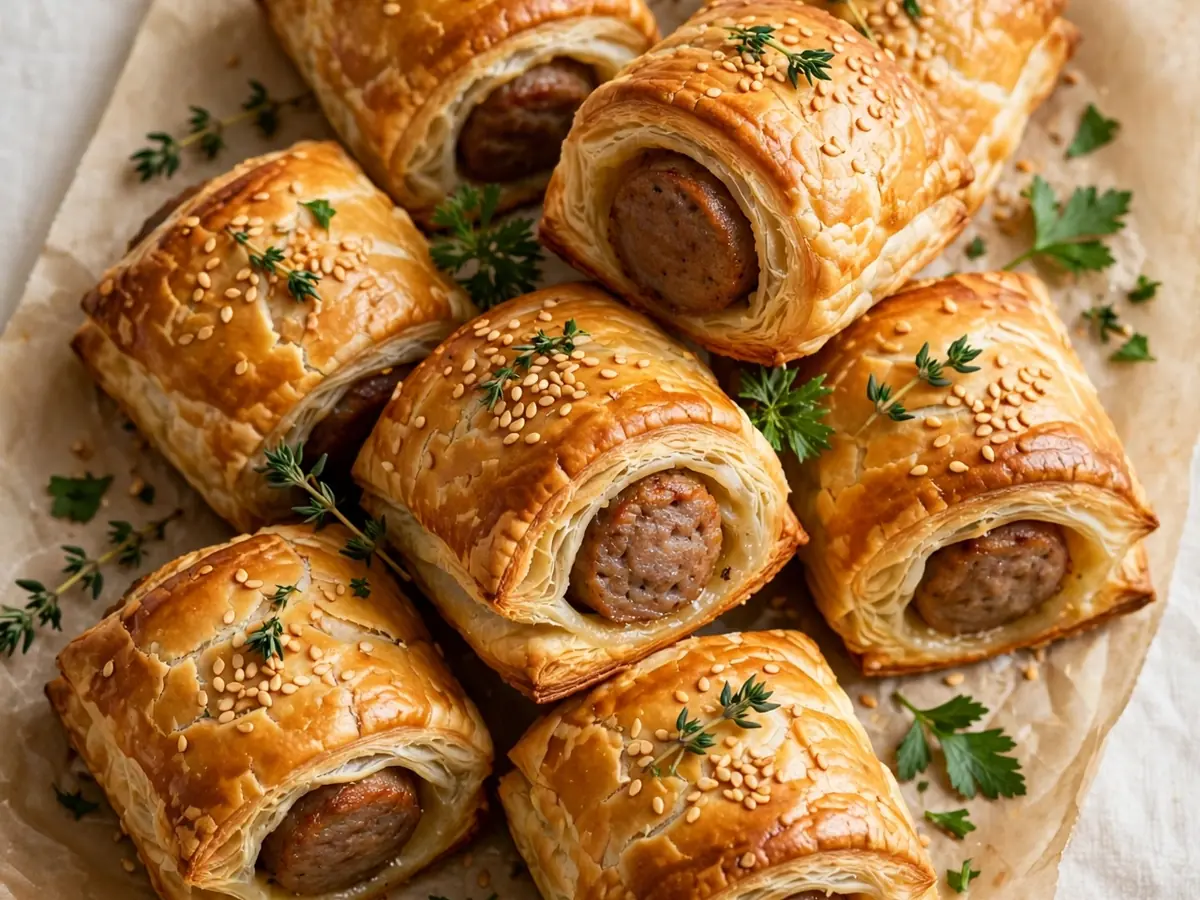
Puff pastry sausage rolls are the quiet heroes of the appetizer table. They arrive golden and shingled on a platter, smell of butter and savory pork, and disappear before the dip bowl has been touched. What makes them so reliable for a party is the same thing that makes them so simple: store-bought puff pastry does most of the heavy lifting, and a well-seasoned sausage filling does the rest. You can assemble a tray in under half an hour, bake them in about twenty-five minutes, and serve them warm, at room temperature, or even reheated the next day. This article walks through a complete, precise recipe for a party-sized batch, with exact quantities, equipment notes, make-ahead guidance, and enough variation ideas to keep the platter interesting without turning your kitchen into a production line.
Why Puff Pastry Sausage Rolls Work for Parties
A good party appetizer needs three qualities: it should be easy to eat standing up, it should hold up on a buffet for an hour or two, and it should taste good without a sauce. Sausage rolls check all three boxes. The pastry casing keeps the filling moist and makes the whole thing portable; the filling is rich enough to eat plain but also welcomes mustard, chutney, or a quick dip. Because they are baked in logs and sliced after baking, one batch yields many small pieces with very little plating effort.
There is also a practical advantage: the entire recipe can be built ahead. You can roll and slice the sausage rolls, freeze them on a tray, and bake them directly from frozen when guests arrive. That flexibility is why this recipe is written with a make-ahead plan built in rather than as an afterthought.
Ingredients
This recipe makes 24 party-sized sausage rolls, which serves about 8 to 10 people as an appetizer alongside other snacks. If you are feeding a larger crowd, double everything and bake on two trays, rotating them halfway through.
For the Filling
- 450 g (1 lb) ground pork, ideally with some fat content (about 20 percent fat)
- 100 g (about 1 cup) fresh white breadcrumbs
- 1 small onion, very finely grated (about 80 g), with excess juice squeezed out
- 2 garlic cloves, finely grated or minced
- 1 teaspoon fine salt
- 1/2 teaspoon freshly ground black pepper
- 1 teaspoon dried sage
- 1/2 teaspoon dried thyme
- 1/4 teaspoon ground nutmeg
- 1 tablespoon Dijon mustard
- 1 large egg, beaten, for the filling
- 2 tablespoons cold whole milk or cold water
For Assembly
- 2 sheets of ready-rolled all-butter puff pastry, about 320 g each (roughly 25 x 35 cm per sheet)
- 1 large egg, beaten with 1 tablespoon water, for egg wash
- 2 tablespoons sesame seeds, poppy seeds, or a mix (optional)
- Flour, for dusting the work surface
For Serving
- Whole-grain mustard, mango chutney, or a small bowl of ketchup
- Optional: a simple honey-mustard dip (3 tablespoons Dijon mustard whisked with 2 tablespoons honey and 1 tablespoon mayonnaise)
Equipment
- Large mixing bowl
- Box grater or microplane for the onion and garlic
- Sharp chef’s knife and a small paring knife
- Large rimmed baking sheet (or two, if your oven is small)
- Parchment paper
- Pastry brush
- Bench scraper or spatula (helpful for lifting rolled logs)
- Cooling rack
- Plastic wrap and a freezer-safe tray for make-ahead storage
Preparation Instructions
- Chill the pastry and preheat the oven. Remove the puff pastry sheets from the freezer and let them thaw in the refrigerator for about 2 hours, or on the counter for 30 to 40 minutes, until pliable but still cold. Cold pastry is easier to work with and puffs better. Preheat the oven to 200°C (400°F) and line a large baking sheet with parchment paper.
- Make the filling. In the large mixing bowl, combine the ground pork, breadcrumbs, grated onion, garlic, salt, pepper, sage, thyme, nutmeg, Dijon mustard, beaten egg, and cold milk. Mix with clean hands or a sturdy spatula just until evenly combined, about 1 minute. Do not overwork the meat, or the filling will become dense. If you want to check the seasoning, fry a small spoonful of the mixture in a pan and taste it, then adjust salt and pepper.
- Divide the filling. Divide the filling into 4 equal portions, roughly 175 g each. Shape each portion into a log about 30 cm long by rolling it gently on a sheet of plastic wrap. This pre-shaping makes it much easier to get an even roll inside the pastry.
- Roll the pastry. Lightly flour the work surface. If your pastry comes in a single large sheet, cut it in half crosswise to make two pieces about 25 x 17 cm; if it is already in two sheets, work with one sheet at a time and keep the other chilled. Lay one sheet with the long edge facing you.
- Add the filling. Place one portion of filling along the long edge nearest you, about 3 cm from the edge, leaving a 2 cm border at each short end. Press the filling gently so it forms an even cylinder.
- Brush and seal. Brush the far long edge of the pastry with egg wash. Fold the near edge over the filling and roll the pastry into a tight log, pressing the seam gently to seal. Roll the log seam-side down. Repeat with the remaining pastry and filling to make 4 logs.
- Chill the logs. Transfer the logs to a parchment-lined tray and refrigerate for 20 minutes. This step firms the pastry and filling so the slices hold their shape and the pastry puffs more dramatically.
- Slice the rolls. Using a sharp knife, cut each log into 6 equal pieces, about 4 to 5 cm wide. Wipe the knife between cuts if the filling starts to stick. Arrange the pieces on the baking sheet about 3 cm apart, cut-side up, so the layered edges are visible.
- Egg wash and top. Brush the top and sides of each piece generously with egg wash. Sprinkle with sesame seeds or poppy seeds if using. Do not egg wash the cut ends, or the layers may seal and prevent puffing.
- Bake. Bake on the middle rack for 22 to 26 minutes, until the pastry is deep golden brown and the filling registers 71°C (160°F) on an instant-read thermometer. Rotate the tray halfway through if your oven browns unevenly. If the tops darken too quickly, tent loosely with foil for the final 5 minutes.
- Rest and serve. Let the sausage rolls rest on the tray for 5 minutes, then transfer to a cooling rack for another 5 minutes. Serve warm or at room temperature with mustard, chutney, or the honey-mustard dip.
Cooking Times and Servings at a Glance
- Prep time: 25 to 30 minutes, plus 20 minutes chilling
- Bake time: 22 to 26 minutes per tray
- Total time: about 1 hour 15 minutes
- Yield: 24 party-sized rolls
- Serves: 8 to 10 as an appetizer, 4 to 6 as a main with a salad
- Internal temperature: 71°C (160°F) for the pork filling
Practical Substitutions
Meat: Ground pork is traditional, but ground turkey, chicken, or a 50/50 blend of pork and beef all work. If using lean poultry, add an extra tablespoon of olive oil to the filling to keep it moist. For a vegetarian version, use 400 g of a firm, well-seasoned plant-based sausage or a mixture of cooked lentils and mushrooms, but reduce the salt by half and skip the raw egg in the filling.
Breadcrumbs: Panko works well and gives a slightly lighter texture. Fresh breadcrumbs from a day-old loaf are ideal. If you only have dried breadcrumbs, use 60 g and add 2 extra tablespoons of milk.
Pastry: All-butter puff pastry gives the best flavor, but any ready-rolled puff pastry works. Avoid phyllo and shortcrust for this recipe; they behave differently and will not give the same lift.
Seasonings: Swap the sage and thyme for 1 teaspoon of fennel seeds and 1/2 teaspoon of smoked paprika for a sausage-style flavor, or add 1/2 teaspoon of chili flakes for heat. A tablespoon of finely chopped fresh parsley stirred in at the end brightens the filling.
Egg wash: Whole milk or a mixture of milk and a little honey can substitute for egg wash, though the browning will be lighter.
Make-Ahead and Storage Guidance
Refrigerator: Store baked sausage rolls in an airtight container in the refrigerator for up to 3 days. Reheat on a baking sheet at 180°C (350°F) for 8 to 10 minutes, or until hot and crisp again. A microwave works in a pinch but softens the pastry.
Freezer, unbaked: This is the best make-ahead method. Arrange the sliced, unbaked rolls on a parchment-lined tray and freeze until solid, about 1 hour, then transfer to a freezer bag for up to 2 months. Bake from frozen at 200°C (400°F) for 28 to 32 minutes, adding 5 minutes to the standard bake time. Egg wash them just before baking.
Freezer, baked: Cool completely, then freeze in a single layer before bagging. Reheat from frozen at 190°C (375°F) for 12 to 15 minutes.
Holding for a party: Keep baked rolls warm in a 90°C (200°F) oven on a tray for up to 30 minutes. For buffets, serve them at room temperature and plan to replenish the platter from a second tray rather than leaving one tray out for hours.
Tips for the Best Results
- Keep everything cold. Warm pastry sticks and tears. Work quickly, and return the pastry to the fridge if it softens.
- Squeeze the onion. Grated onion releases a lot of water. Wrapping it in a clean kitchen towel and squeezing removes excess moisture that would otherwise make the pastry soggy.
- Do not overfill. Too much filling bursts the pastry and makes slicing messy. The 175 g portions are calibrated for standard pastry sheets.
- Use a sharp knife and a clean cut. Press down firmly rather than sawing, and wipe the blade between cuts for neat slices.
- Season the filling properly. The fry-and-taste test is the single best way to avoid bland sausage rolls. Pork mixtures need adequate salt.
- Space the pieces. Crowding the tray steams the pastry instead of browning it.
- Serve with something sharp. Mustard, chutney, or a tangy dip cuts through the richness of the pastry and pork.
Variations to Try
Honey-mustard sausage rolls: Brush the finished rolls with a glaze of 2 tablespoons honey mixed with 1 tablespoon Dijon mustard during the last 5 minutes of baking.
Apple and sage: Add 1 small peeled, grated apple (squeezed dry) and an extra 1/2 teaspoon of sage to the filling for a sweeter, autumnal flavor.
Cheese and chive: Fold 60 g of grated sharp cheddar and 2 tablespoons of chopped chives into the filling; reduce the salt to 3/4 teaspoon.
Mini cocktail size: Cut each log into 10 to 12 pieces instead of 6, bake for 18 to 20 minutes, and serve with toothpicks.
If you enjoy party-friendly baking projects, the kirarecipes blog has more ideas for crowd-pleasing appetizers and desserts, including a cream-filled donuts treat that makes a fun sweet finish to the same table.
Frequently Asked Questions
Can I make puff pastry sausage rolls ahead of time?
Yes. The best method is to assemble and slice the rolls, freeze them unbaked on a tray until solid, then bag them for up to 2 months. Bake from frozen at 200°C (400°F) for 28 to 32 minutes. You can also refrigerate assembled, unbaked rolls for up to 24 hours before baking; add 2 to 3 minutes to the bake time since they will go into the oven cold.
Why did my sausage rolls turn out soggy on the bottom?
Sogginess usually comes from excess moisture or an underheated oven. Make sure the grated onion is squeezed dry, do not add extra liquid to the filling, and preheat the oven fully before baking. Baking on parchment on a rimmed sheet at 200°C (400°F) helps, and if your pastry was very cold or wet, pat it dry before rolling. Serving them on a cooling rack rather than a flat plate also prevents steam from softening the base.
What is the best internal temperature for sausage rolls?
The pork filling should reach 71°C (160°F) on an instant-read thermometer inserted into the center of a roll. At that point the pastry is usually deep golden brown. If the pastry is browning faster than the filling cooks, tent the tray loosely with foil and continue baking until the temperature is reached.
Can I use a different type of meat or make them vegetarian?
Ground turkey, chicken, or beef all work, though lean meats benefit from an extra tablespoon of oil in the filling. For a vegetarian version, use a firm plant-based sausage or a cooked lentil and mushroom mixture, reduce the salt, and omit the raw egg from the filling. Check that your puff pastry is made without animal fats if you need the recipe to be fully vegetarian.
How many sausage rolls should I plan per person?
For an appetizer spread with other snacks, plan on 2 to 3 party-sized rolls per person, which means this 24-piece batch serves 8 to 10 people comfortably. If sausage rolls are the main finger food, plan on 4 to 5 per person and double the recipe for a crowd of 20 or more.
How do I reheat leftover sausage rolls without drying them out?
Reheat in a 180°C (350°F) oven for 8 to 10 minutes, or until hot and crisp. Covering them loosely with foil for the first 5 minutes helps retain moisture, then uncover for the last few minutes to re-crisp the pastry. Avoid the microwave if you can, since it makes the pastry chewy rather than flaky.