Eggnog French Toast Casserole for Holiday Brunch
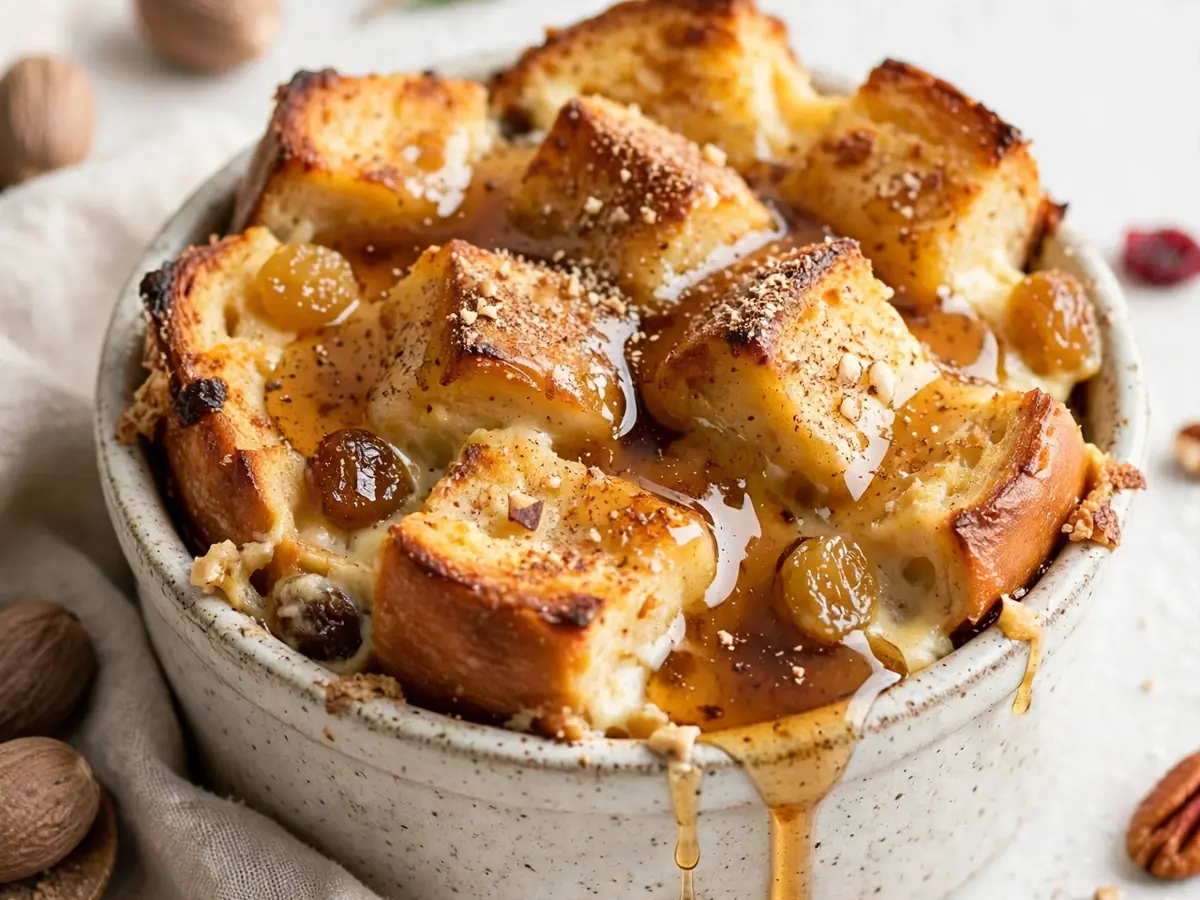
Eggnog French toast casserole takes the flavors of a holiday drink and turns them into a warm, make-ahead breakfast that feeds a crowd. Cubes of bread soak overnight in a custard of eggnog, eggs, and warm spices, then bake into a golden, puffed dish with a soft, bread-pudding-like center and crisp edges. A quick streusel topping adds crunch, and a simple spiced maple syrup ties everything together. Because it is assembled the night before, holiday morning stays calm: preheat the oven, slide the dish in, and set out toppings while it bakes. This article covers exact quantities, equipment, step-by-step instructions, make-ahead timing, substitutions, storage, and answers to common questions so the casserole works the first time and every time after.
Why Eggnog French Toast Casserole Works for Holiday Brunch
French toast usually means standing at the stove, dipping slices one at a time while guests wait. A casserole removes that bottleneck. The bread is cubed, the custard is whisked in one bowl, and everything is combined in a baking dish. The oven does the rest. Eggnog is already a seasoned custard base of milk, cream, eggs, sugar, and nutmeg, so it shortcuts the measuring and balancing that a from-scratch custard requires. The result tastes richer than standard French toast without extra effort.
The dish is also forgiving. Slightly stale bread is better than fresh bread because it absorbs custard without turning to mush. The casserole can be assembled up to 24 hours ahead, baked straight from the refrigerator with a few extra minutes, and held warm for a short while before serving. It scales to a 9-by-13-inch pan to serve 8 to 10 people, which suits a holiday table where people eat in waves. For a smaller group, the recipe halves cleanly into an 8-inch square dish. If you are feeding a crowd with mixed ages, this is the kind of dish that pleases both kids and adults without a separate menu.
Ingredients
This recipe makes one 9-by-13-inch casserole, serving 8 to 10 people. Use a scale for the bread if possible; volume measurements of cubed bread vary a lot depending on how tightly it is packed.
For the casserole
- 12 ounces (about 340 g) day-old challah, brioche, or sturdy white sandwich bread, cut into 1-inch cubes (roughly 10 to 11 cups, lightly packed)
- 2 1/2 cups (600 ml) prepared eggnog, regular or low-fat but not sugar-free
- 4 large eggs
- 1/2 cup (120 ml) whole milk
- 1/4 cup (50 g) granulated sugar
- 1 teaspoon vanilla extract
- 3/4 teaspoon ground nutmeg, preferably freshly grated
- 1/2 teaspoon ground cinnamon
- 1/4 teaspoon fine salt
- 2 tablespoons (28 g) unsalted butter, softened, for greasing the dish
For the streusel topping
- 1/3 cup (45 g) all-purpose flour
- 1/3 cup (65 g) packed light brown sugar
- 1/2 teaspoon ground cinnamon
- Pinch of fine salt
- 3 tablespoons (42 g) cold unsalted butter, cut into small pieces
- 1/3 cup (40 g) chopped pecans or walnuts (optional)
For serving
- Maple syrup, warmed
- Whipped cream, lightly sweetened
- Fresh orange segments or berries, optional
- Extra ground nutmeg for dusting
Equipment
- 9-by-13-inch (23-by-33 cm) baking dish, glass or ceramic, at least 2 1/2 inches deep
- Large mixing bowl
- Whisk
- Measuring cups and spoons, or a kitchen scale
- Small bowl and fork or pastry cutter for the streusel
- Aluminum foil
- Rimmed baking sheet (optional, to catch drips)
- Instant-read thermometer (optional, for checking doneness)
Preparation Instructions
- Dry the bread if needed. If your bread is fresh and soft, spread the cubes on a rimmed baking sheet and leave them at room temperature for 1 to 2 hours, or toast at 300°F (150°C) for 8 to 10 minutes, stirring once, until dry to the touch but not browned. Skip this step if the bread is already a day or two old and slightly firm.
- Grease the dish. Rub the softened butter generously over the bottom and sides of the 9-by-13-inch baking dish, reaching into the corners.
- Layer the bread. Spread the bread cubes evenly in the prepared dish. Do not pack them down; a loose, even layer lets the custard distribute.
- Whisk the custard. In the large bowl, whisk the eggnog, eggs, milk, granulated sugar, vanilla, nutmeg, cinnamon, and salt until completely smooth and the sugar has dissolved, about 1 minute. Scrape the bottom of the bowl to catch any unmixed egg.
- Pour and press. Pour the custard slowly and evenly over the bread. Press down gently on the cubes with the back of a spoon or a spatula so every piece gets coated. Some bread will stick up above the liquid; that is fine and gives the top texture.
- Chill. Cover the dish tightly with foil and refrigerate for at least 4 hours or up to 24 hours. Overnight is ideal for flavor and texture.
- Make the streusel. In a small bowl, combine the flour, brown sugar, cinnamon, and salt. Add the cold butter pieces and work them in with a fork or fingertips until the mixture looks like coarse crumbs with some pea-sized clumps. Stir in the nuts, if using. Cover and refrigerate until baking time.
- Rest before baking. Remove the casserole from the refrigerator and uncover it. Let it stand at room temperature for 20 to 30 minutes while the oven preheats. This reduces the cold-center problem.
- Preheat. Heat the oven to 350°F (175°C) with a rack in the middle position.
- Top and bake. Scatter the streusel evenly over the casserole. Set the dish on a rimmed baking sheet to catch any bubbling custard. Bake uncovered for 40 to 50 minutes, until the center is set and no longer jiggles when the dish is nudged, the top is golden brown, and an instant-read thermometer inserted in the center reads 170°F to 175°F (77°C to 79°C). If the top browns too quickly after 30 minutes, tent loosely with foil.
- Rest. Let the casserole stand for 10 to 15 minutes before serving. This allows the custard to finish setting and makes cleaner portions.
- Serve. Cut into squares and serve warm with warmed maple syrup, whipped cream, fruit, and a light dusting of nutmeg.
Cooking Times and Make-Ahead Schedule
The total active time is about 20 minutes, plus 4 to 24 hours of chilling. Baking takes 40 to 50 minutes at 350°F (175°C). A 24-hour chill produces a slightly softer, more custard-heavy center; a 4-hour chill is firmer and more bread-forward. Both are correct.
Holiday morning timeline: The night before, assemble the casserole and streusel and refrigerate both. On the morning of, take the casserole out 30 minutes before baking, preheat the oven, add the streusel, and bake. If you want to serve at 10 a.m., start the oven at 9:05 a.m. and pull the dish out around 9:50 a.m. to rest.
To bake from frozen: Assemble and freeze unbaked (without streusel). Thaw overnight in the refrigerator, then proceed as written, adding 5 to 10 minutes to the bake time if the center is still cold.
Practical Substitutions
- Bread: Challah and brioche give the richest result. Sturdy white sandwich bread, French bread, or Texas toast work well. Avoid very soft, presliced sandwich bread, which collapses. Cinnamon-raisin bread is a good swap for a sweeter casserole.
- Eggnog: Use regular or low-fat eggnog, but not sugar-free, which lacks the body the custard needs. If you have no eggnog, combine 2 cups whole milk, 1/2 cup heavy cream, 3 tablespoons sugar, 1/2 teaspoon nutmeg, and 1/4 teaspoon cinnamon and use in place of the eggnog, then reduce the added sugar in the recipe to 2 tablespoons.
- Dairy-free: Use a plant-based eggnog and unsweetened oat or soy milk, and swap the butter for a dairy-free margarine. Choose a dairy-free bread.
- Nuts: Omit for a nut-free version, or replace with an equal amount of old-fashioned oats for crunch.
- Alcohol note: This recipe uses no alcohol. If your eggnog is a spiked variety, the alcohol does not fully bake off, so choose a non-alcoholic eggnog for a family brunch.
- Halving: Use an 8-inch square dish, keep the same custard ratio, and bake 30 to 38 minutes. The center should still read 170°F to 175°F.
Tips for the Best Result
- Weigh the bread. Twelve ounces by weight is the reliable anchor. Too much bread makes a dry casserole; too little makes a soggy one.
- Do not skip the rest. Letting the dish sit out for 20 to 30 minutes before baking is the single easiest way to avoid a cold, wet center.
- Watch the top, not just the timer. Ovens vary. Judge doneness by the center’s set and the internal temperature, not by the clock alone.
- Keep the streusel cold. Cold butter creates clumps that stay crisp. Warm butter melts into a paste that bakes flat.
- Warm the syrup. A few seconds in the microwave or a small saucepan makes a noticeable difference in how the dish tastes.
- Serve promptly. The casserole is best within 45 minutes of baking. If it must wait, cover loosely with foil and keep it in a 200°F (95°C) oven for up to 30 minutes.
Storage and Reheating
Refrigerator: Cool leftovers within 2 hours, cover tightly, and refrigerate for up to 3 days. Store the streusel separately if any remains.
Freezer: Baked casserole freezes well for up to 2 months. Cut into portions, wrap tightly, and freeze. Thaw overnight in the refrigerator.
Reheating: Reheat individual portions in a 325°F (165°C) oven for 12 to 15 minutes, covered with foil, until heated through to 165°F (74°C). A microwave works for single servings in 45-second bursts, though the texture will be softer. Avoid reheating the whole dish at high heat, which dries the edges.
Food safety: Because the custard contains eggs and dairy, do not leave the casserole at room temperature for more than 2 hours total, including serving time.
Variations to Try
- Cranberry-orange: Scatter 1/2 cup dried cranberries and 1 teaspoon orange zest over the bread before adding the custard, and add 1/2 teaspoon orange zest to the streusel.
- Gingerbread twist: Add 1/2 teaspoon ground ginger and 1/4 teaspoon ground cloves to the custard and swap 2 tablespoons of the brown sugar in the streusel for molasses.
- Chocolate chip: Sprinkle 1/2 cup mini chocolate chips over the bread layer; they sink slightly and create pockets of melted chocolate.
For another make-ahead brunch idea with a similar hands-off approach, see our easy French toast sticks breakfast. If you are planning a sweets table alongside brunch, our cream filled donuts treat is a good companion, and more seasonal ideas live in the blog.
Frequently Asked Questions
Can I assemble eggnog French toast casserole the same morning?
Yes, but allow at least 2 hours of refrigeration before baking so the bread absorbs the custard. A 4-hour chill is better, and overnight is best. If you are short on time, use drier, sturdier bread and press the cubes gently into the custard to speed absorption.
How do I know when the casserole is fully baked?
The center should be set with no loose liquid, the top golden brown, and the dish should not jiggle when nudged. An instant-read thermometer inserted in the center should read 170°F to 175°F (77°C to 79°C). If the top browns before the center sets, tent with foil and continue baking.
Can I use homemade eggnog instead of store-bought?
Yes. Use 2 1/2 cups of your homemade eggnog and reduce the added granulated sugar to 2 tablespoons, since homemade versions vary in sweetness. Taste the custard before pouring and adjust the sugar if needed. Do not use a spiked eggnog for a family brunch, as the alcohol does not fully bake off.
Why did my casserole turn out soggy?
The usual causes are fresh, soft bread, too much custard for the amount of bread, or baking from cold without a rest. Use day-old or lightly dried bread, weigh it to 12 ounces, and let the dish stand at room temperature for 20 to 30 minutes before baking. Baking until the center reaches 170°F to 175°F also helps drive off excess moisture.
Can I make this casserole dairy-free or gluten-free?
For dairy-free, use plant-based eggnog, unsweetened oat or soy milk, dairy-free margarine, and a dairy-free bread. For gluten-free, choose a sturdy gluten-free bread and gluten-free all-purpose flour in the streusel. Check that all packaged ingredients are certified gluten-free if cross-contact is a concern.
How long can leftovers stay in the refrigerator?
Cover tightly and refrigerate for up to 3 days. Reheat portions in a 325°F (165°C) oven, covered, for 12 to 15 minutes, or microwave single servings in short bursts. Do not leave the casserole at room temperature for more than 2 hours total.